GLM 5.3-max vs. Gemini 4 (Argon)
A technical comparison of single-prompt 3D WebGL game generation. Both models were given an identical 64-line specification prompt to engineer a self-contained 11-module Star Fox rail shooter set along a golden-hour flight corridor through Kuala Lumpur. ⚠ Note: The game is optimized exclusively for desktop browsers with physical keyboard navigation, not for touch-based mobile devices.
Kilo Code IDE Agent
Single-Shot Prompt with Built-In Automated Test Harness
- Artifact Size: 99.1 KB
- Lines of Code: 2,903 LOC
- Coordinate Model: Absolute Z (0 → 10,800)
- WebAudio DSP: Bandpass White Noise + Saw
- Ship Geometry: Inverted Cone Nose (Boxy)
- Automated Harness: Passes CDP verify.js 9/9
Gemini App Harness
Single-Shot Prompt • Pure Raw Output Benchmark
- Artifact Size: 99.7 KB
- Lines of Code: 2,984 LOC
- Coordinate Model: Origin-Anchored World Scroll
- WebAudio DSP: 9 Polyphonic Synthesizer Voices
- Ship Geometry: Canonical Arwing + G-Diffusers
- Visual Aesthetics: Layered Sunset + CRT Scanlines
Cyber-Nusantara Overdrive
Post-Benchmark Malaysian Cultural Fine-Tuning
- Artifact Size: 167.2 KB
- Lines of Code: 4,325 LOC
- Soundtrack: Procedural Gamelan-Synthwave BGM
- Transformations: "Gergasi Pendekar" Mecha Mode
- Branching Route: Subterranean SMART Tunnel vs Storm
- Arcade Comms: Star Fox Wingman Talk Heads
Session Details & Model Tooling Setup
Examining the development environment and generation harness behind each model's delivery:
Readers may ask: Why benchmark Gemini 4 (Argon) against GLM 5.3-max?
There is no grand experimental design here. I wanted to test Google's new Argon model, I wanted a comparative baseline, and I happened to have GLM 5.3-max tokens immediately available in Kilo Code. So I ran the prompt through both. While a textbook shootout would pit Argon directly against its frontier peers (such as Claude 3.5/Opus 5.5 or GPT-6 Sol), this run was an opportunistic experiment using what was readily on hand to see how each handled complex, single-prompt 3D WebGL generation.
Kilo Code IDE Agent (GLM 5.3-max)
Autonomous IDE Agent
Environment: Kilo Code extension in a local workspace (kl-star-runner).
- Methodology: Autonomous code-and-verify loop. The agent wrote
index.html(2,903 LOC) and simultaneously generated a 370-line headless verification harness:verify.js. - Automated Test Rigging: Exported
window.__KL_TEST_HOOKS__into the global browser scope, exposing internal singletons (GAME,SHIP,BULLETS,ENEMIES,BOSS,HUD,AUDIO,CONFIG). - Verification Rigor: Executed Chrome in headless CDP mode (
--headless=new --remote-debugging-port=9222) to programmatically step physics, spawn drones, fire lasers, confirm damage, trigger smart bombs, and assert score persistence across page reloads. - Trade-Off: While mechanically robust with 100% test gate compliance, spatial aesthetic intuition was compromised (inverted nose cone rotation, flat black plane, harsh horizon clipping).
Gemini App Harness (Gemini 4 Argon)
Raw 1-Shot Chat InferenceEnvironment: Google Gemini App Harness running the Gemini 4 (Argon) foundation model.
- Methodology: Pure 1-shot inference from
Build KL StarFox.txtwithout terminal access, sub-agents, or automated test runners. Delivered in a single prompt turn askl-star-runner-argon-v1.html(2,984 LOC). - Spatial & Visual Intuition: Accurately calculated 3D Euler angles, canonical Arwing pylon sweeps, camera lag offsets, and an atmospheric golden-hour scattering shader with a glowing sun disc.
- Mathematical Origin Anchoring: Anticipated long-corridor floating-point jitter by keeping the player anchored near Z=0 and scrolling world coordinates backward.
- Polyphonic DSP: Synthesized a 9-voice polyphonic WebAudio soundscape with sub-bass harmonic layering without needing audio asset files.
In-Flight Animation & Physics Shootout
Generated using automated Chromium DevTools Protocol (CDP) capturing at 1280×720 with synchronized 100ms game loops. Notice the striking spatial reasoning and aesthetic differences between the two models from the identical prompt.
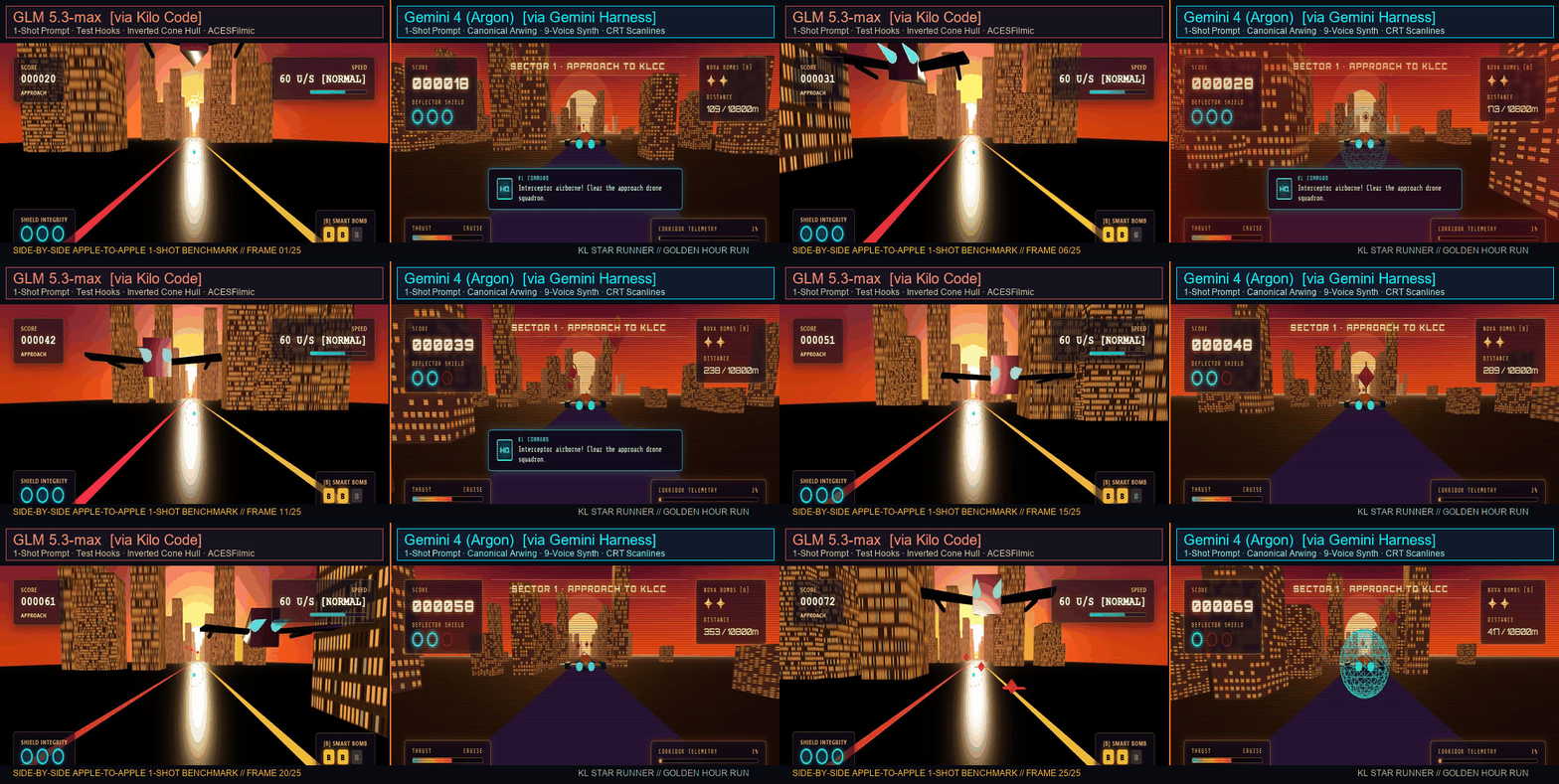
GLM 5.3-max (Kilo Code) Observations
- Inverted Ship Orientation: The nose cone rotation was calculated as
rotateX(π/2); rotateZ(π/4), flipping the base forward and hanging upside-down near the ceiling like a pendant. - Flat Highway Floor: Ground plane is pure black with static red and yellow laser lines, giving a sparse wireframe look.
- Monochrome Windows: Procedural building texture uses uniform yellow squares without color temperature or setback variance.
- Stepped Horizon: Skybox shader clamps harshly at the horizon, resulting in dark, hollow zenith transitions.
- 2D Screen Reticle: Aiming reticle is locked to screen center rather than projecting forward in 3D world space.
Gemini 4 (Argon) Observations
- Canonical Arwing Silhouette: Proportional central fuselage with swept blue G-Diffuser engine pylons, glowing cockpit canopy, and banking roll dynamics.
- Atmospheric Golden Hour: Custom three-stop shader (amber → dusty rose → indigo) with glowing sun disc geometry and CRT scanline overlay.
- Dual-Palette Window Lighting: Randomly weighted 80% warm amber/gold and 20% cool cyber-cyan windows create genuine city vibrancy.
- Star Fox Radio Transmission Comms: Interactive dialog box triggers mission context (
[HQ] KL COMMAND) and dynamic boss warnings. - 3D Holographic Reticle: Target reticle is rendered as a 3D ring positioned 28 units ahead of the ship, providing authentic rail-aiming feedback.
Milestone Asset & Interface Breakdown
Compare how each model interpreted the benchmark requirements across different game phases:
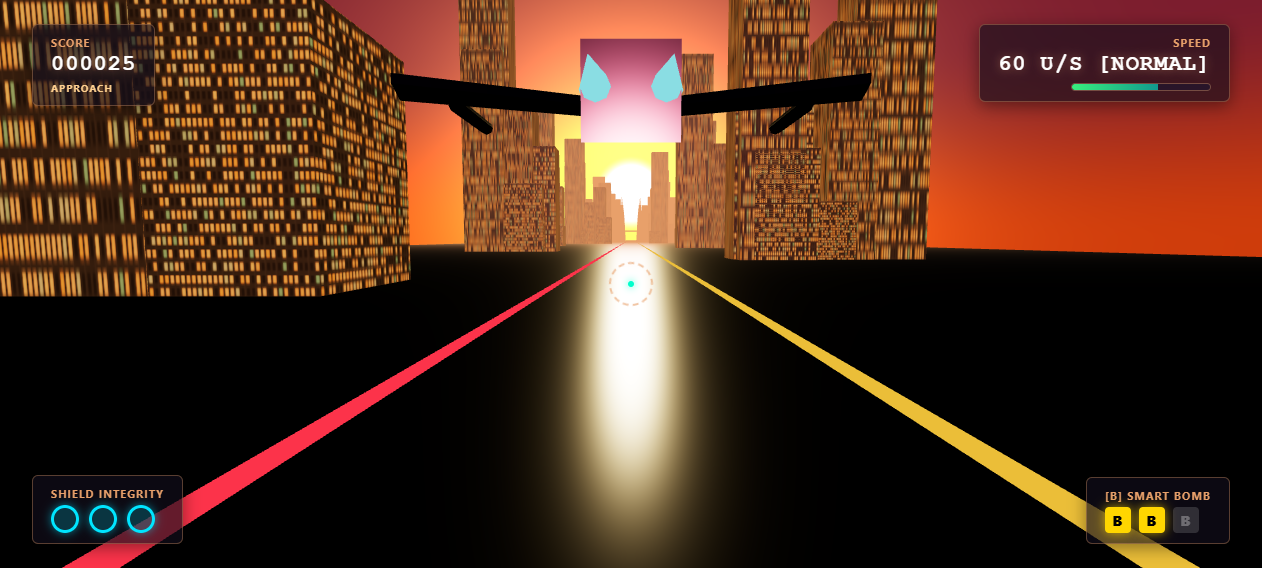
High camera angle looking down on a flipped pink cone hull. Buildings are densely instanced but lack vertical lighting falloff. Flight boundaries are strictly enforced but the craft occupies awkward upper-screen real estate.
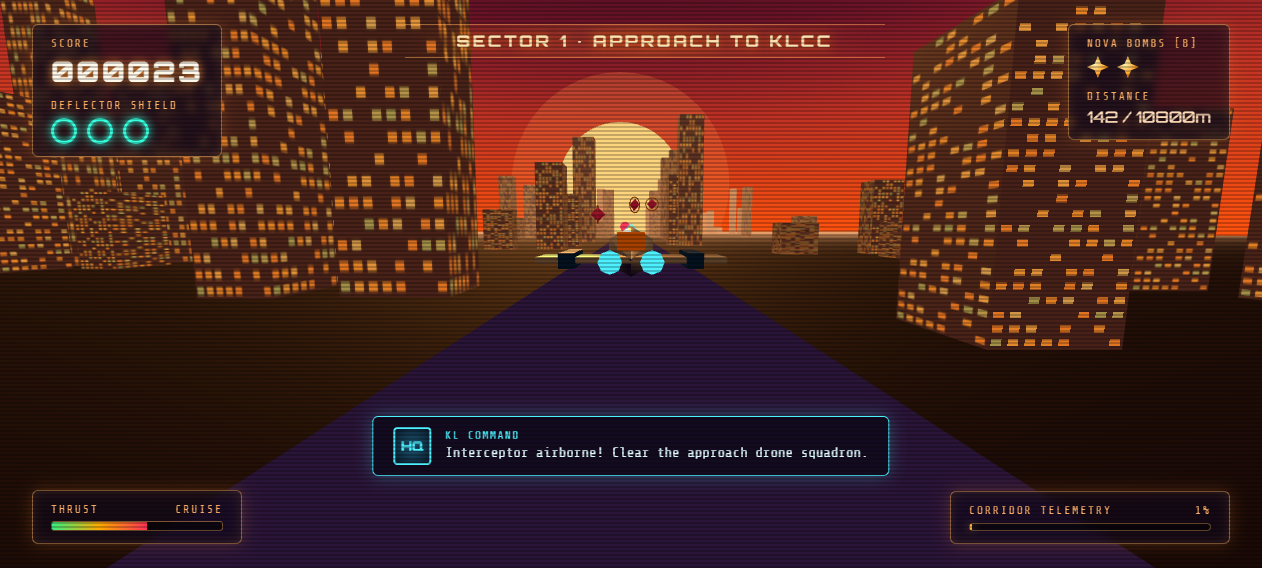
True third-person Arwing flight framing. The sun sets directly behind the corridor axis. HUD displays real-time telemetry, cruise speed throttle, Nova Bomb diamond count, and incoming HQ communications.
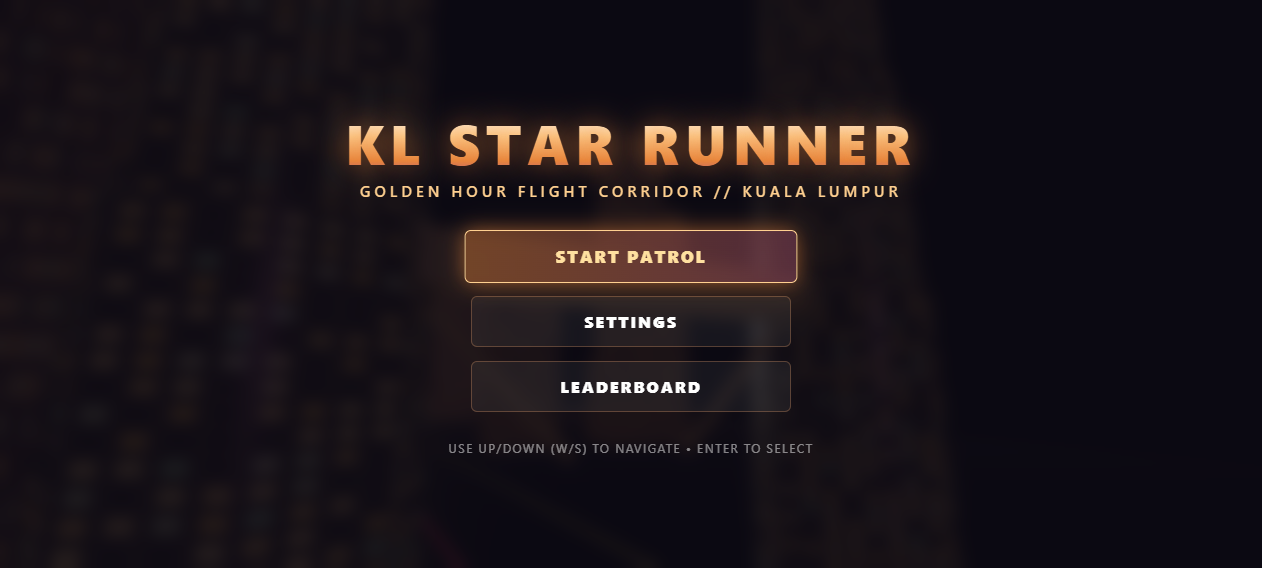
Minimalist modern menu with blurred backdrop. Clean button layout with keyboard hint footer. Settings and Leaderboard fully functional via local storage.
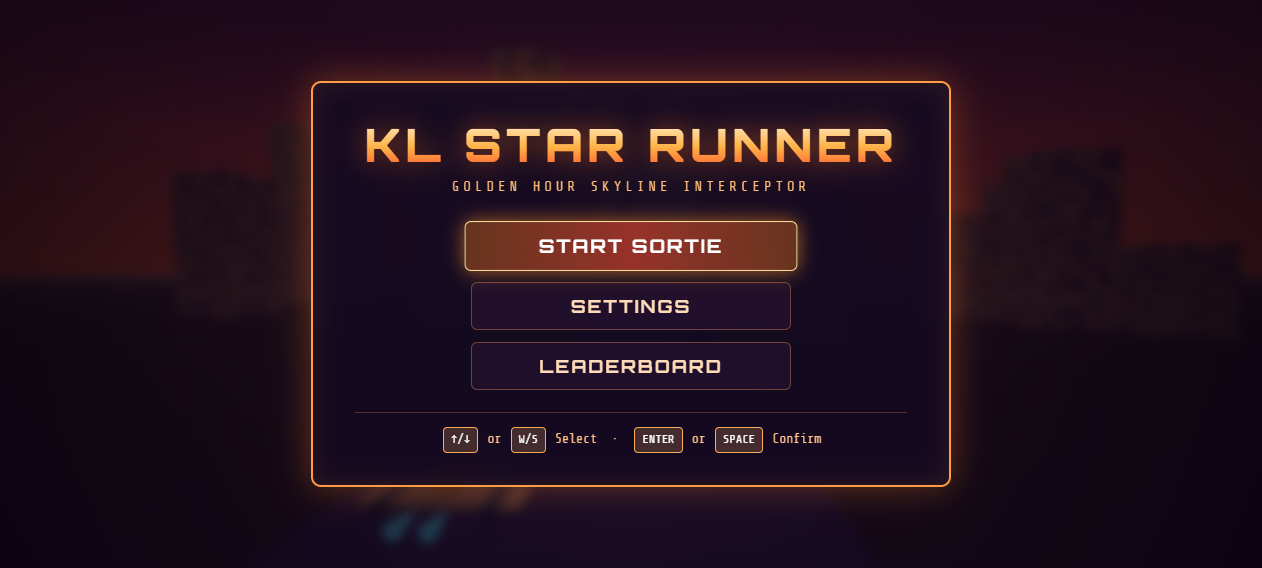
Arcade cyber-cabinet styling with neon amber glowing border box, Orbitron typography, CRT scanlines, and highlighted keyboard key badges ([↑/↓] or [W/S] Select).
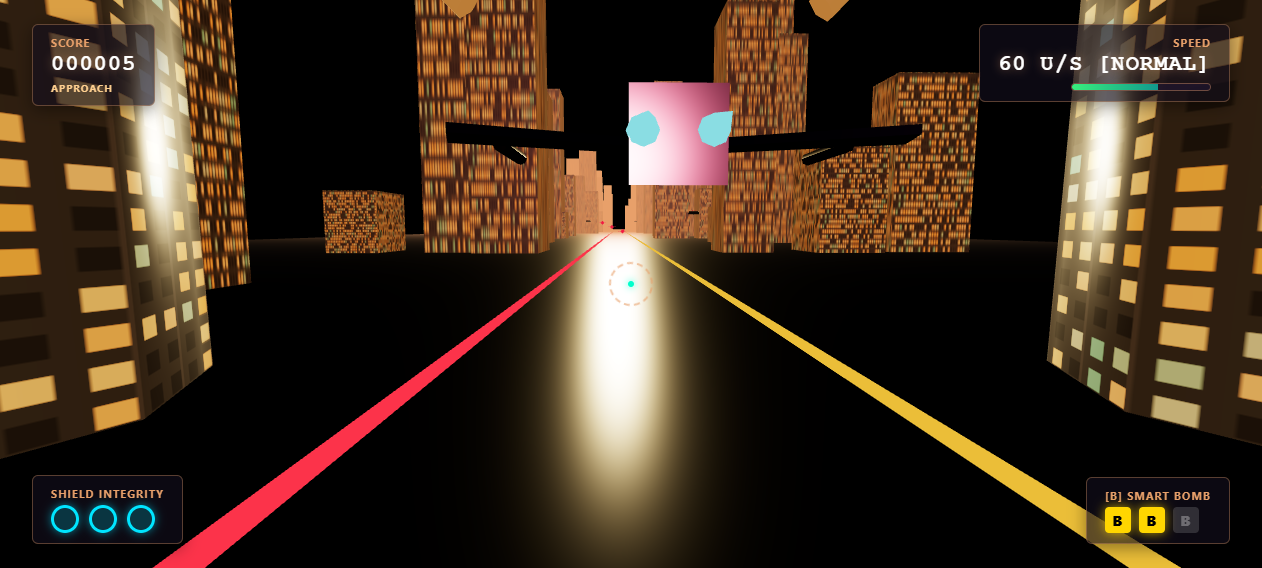
Towers placed at Z=2650. While stepped tiers and skybridge were constructed in code, extreme camera clipping and tight fog cause the upper spires to blend into the dark background.
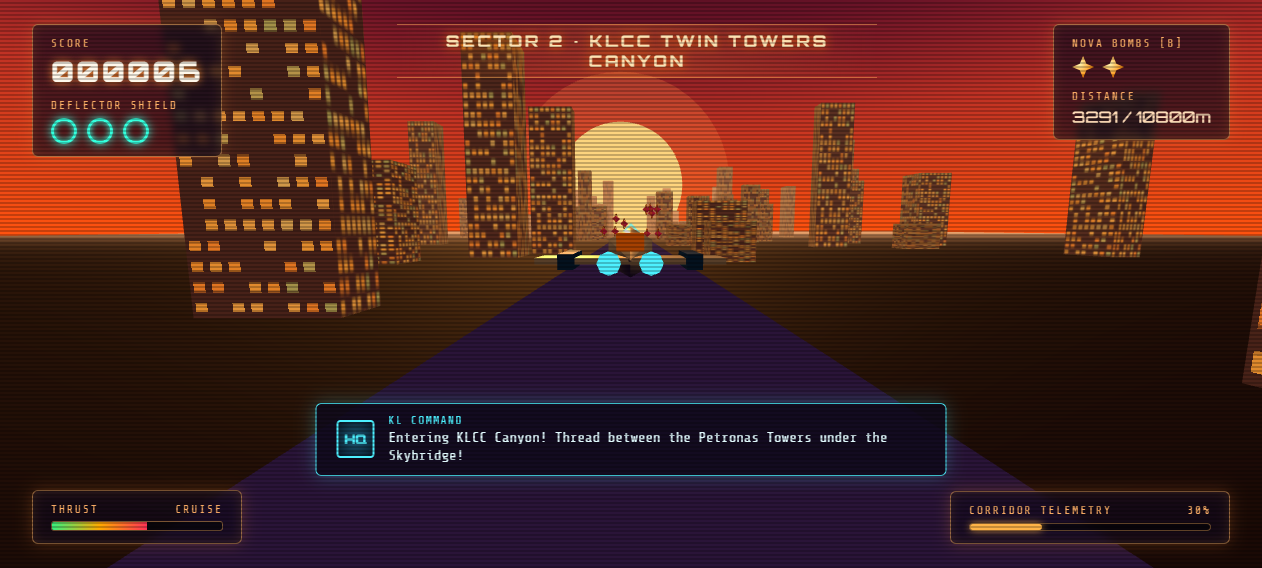
Petronas Towers rise with distinct stepped setbacks, reflective metallic materials, glowing skybridge connectors, and radio chatter instructing the pilot to dive under the bridge.
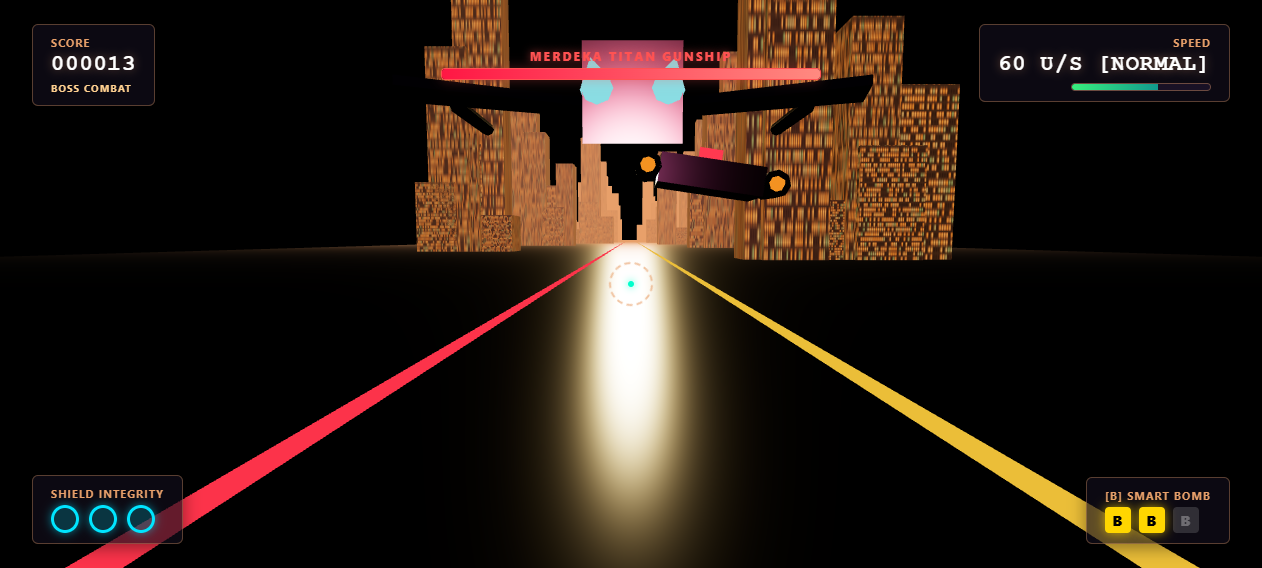
Boss gunship spawns at Z=8520 directly below the ship's nose. Simple box cruiser mesh with twin orange jet cones. Fixed sine hovering pattern with health bar overlay.
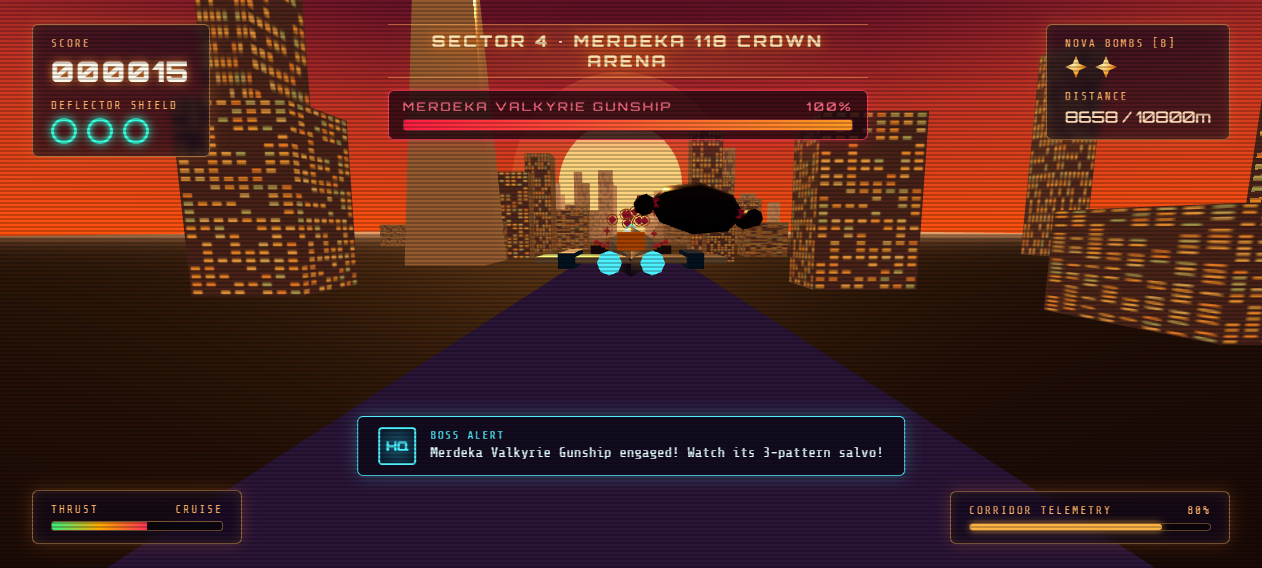
Merdeka 118 silhouette towers behind the arena with its iconic diamond crown and offset spire. The Valkyrie Gunship features multi-phase attack patterns, glowing reactor core, and alarm klaxons.
Comprehensive Technical Spec Matrix
Side-by-side audit of all 11 prompt modules requested in the 1-shot specification:
| Architecture Module | GLM 5.3-max (Kilo Code) | Gemini 4 Argon (Gemini App) |
|---|---|---|
| 1. Flight Coordinate System |
Absolute World Z (0 → 10,800) Ship advances down Z axis. Requires continuous camera chase recalculation; prone to 32-bit float jitter past 8,000 units. |
Origin-Anchored World Scroll SUPERIOR Player craft stays centered near Z=0; worldGroup.position.z scrolls backward. Zero float degradation over long corridors.
|
| 2. 3D Ship Mesh Topology |
Inverted Cone Nose Rotation Euler matrix inverted the fuselage; flat extruded polygon wings; 2D screen-space crosshair. |
Canonical Arwing Starfighter SUPERIOR Multi-part craft with blue G-Diffuser wing pylons, glowing cockpit canopy, dual thruster flames, and 3D world-space targeting reticle. |
| 3. Atmosphere & Skybox |
Basic GLSL Vertex/Fragment Sphere 3-stop linear color blend; harsh horizon cutoff; high-altitude clipping to black. |
Multi-Layer Atmospheric Scattering SUPERIOR Non-linear altitude curving (amber → dusty rose → indigo); glowing 175-unit sun disc; CRT scanlines post-process. |
| 4. Procedural Buildings |
InstancedMesh (6 Height Classes) Canvas window texture generated with uniform amber lights; flat building shading without ambient occlusion. |
InstancedMesh with Dual-Palette Windows SUPERIOR Canvas texture weighted 80% amber / 20% cyber-cyan; nearest-neighbor sampling; varied building setbacks. |
| 5. WebAudio Sound DSP |
White Noise Loop + Saw Laser Pre-built 2s white noise buffer; Biquad bandpass engine filter; 1 sawtooth laser pitch drop; basic noise explosion. |
9-Voice Polyphonic Synthesizer SUPERIOR Sub-bass oscillator + noise engine layer; dual square/saw lasers; 2-stage sub-bass explosions; 3-burst boss klaxon; harmonic UI blips. |
| 6. Boss Encounter Design |
KUL-Titan Cruiser (100 HP) Single attack loop; sine wave hover; drops half-health supply at 50% HP; health bar rendered over player ship. |
Merdeka Valkyrie Gunship (100 HP) SUPERIOR 3 distinct salvo patterns; health-phase scaling at 66% and 33%; guaranteed +1 bomb drop; dramatic comms alerts. |
| 7. Landmark Accuracy |
Petronas, KL Tower, Merdeka 118 Geometric approximations built, but camera positioning and fog render them difficult to spot during combat. |
Iconic Silhouette Landmarks SUPERIOR Merdeka 118 diamond crown and offset spire dominate Sector 4 arena; Petronas skybridge canyon flight path. |
| 8. HUD & Feedback |
Minimalist Standard HUD Score counter, speed gauge, 3 circular shield rings, bomb squares, damage vignette. |
Full Star Fox Arcade Cabinet HUD SUPERIOR Orbitron typography, Star Fox HQ radio comms transmission boxes, Nova Bomb diamond stars, distance counter, speed cruise bar. |
| 9. Automated Test Hooks |
Explicit Test Harness Export SUPERIOR Exports window.__KL_TEST_HOOKS__ for CDP browser test automation; flawlessly passes all 9 verification gates.
|
Clean Encapsulated ES Module Variables encapsulated inside module scope; requires DOM/keyboard event simulation for external orchestration. |
| 10. Leaderboard & Persistence |
localStorage 'kl-starfox-save' Top 10 scores, 3-char initials entry, audio volume and sensitivity persistence. |
localStorage 'kl-starfox-save' Defensive JSON schema validation, top 10 arcade score list, volume/sensitivity sliders with instant live audio feedback. |
Architectural Deep Dive
Examining the foundational math and software engineering decisions that drove the outcome:
1. The Coordinate Origin Decision: Scrolling World vs. Advancing Ship
In 3D rail shooters, players traverse long distances (10,800 units in this spec). GLM moved the ship and camera continuously forward into positive Z space. Gemini Argon chose the gold-standard game engine pattern: anchor the player at Z=0 and translate the world geometry backward.
2. WebAudio DSP Architecture: Dual Oscillator Layering
Without external audio files, synthetic sound richness depends on oscillator layering. GLM relied on a single filtered noise buffer for engine hum. Gemini Argon layered a pure sawtooth oscillator at 58Hz with the bandpass noise generator, introducing the deep harmonic rumble characteristic of sci-fi spacecraft engines.
3. Algorithmic Complexity & Draw Call Budget (from Gemini Tech Specs)
As documented in the project's technical specifications, frame execution time remains locked at < 4.5ms per tick (sustaining 120 FPS on integrated GPUs) via strict batching:
- Single Draw Call City: All 420 procedural buildings render in 1 single WebGL draw call using
THREE.InstancedMeshwith matrix buffers. - Single Draw Call Weather: 900 monsoon rain particles update in-place in a single
Float32Array(2700)inside oneTHREE.Pointsbuffer (1 draw call). - Bounded Collision Complexity: Early Z-axis spatial distance pruning (
Math.abs(worldZ - shipZ) < threshold) discards 95% of candidates before executing Euclidean squared-distance checks. - Ultra-Lightweight Footprint: Zero external assets, zero textures to download, and an aggregate VRAM/audio buffer footprint under 2.5 MB.
The Malaysian Evolution: v1 → v2 → v3
Having validated Gemini Argon's clear superiority in the apple-to-apple 1-shot contest, the engine was pushed further with domain-specific enhancements. Follow the progression from the baseline arcade shooter into a culturally localized, mechanically deep cyber-nusantara masterpiece.
KL Star Runner v2.0: "Ultimate Malaysian Edition"
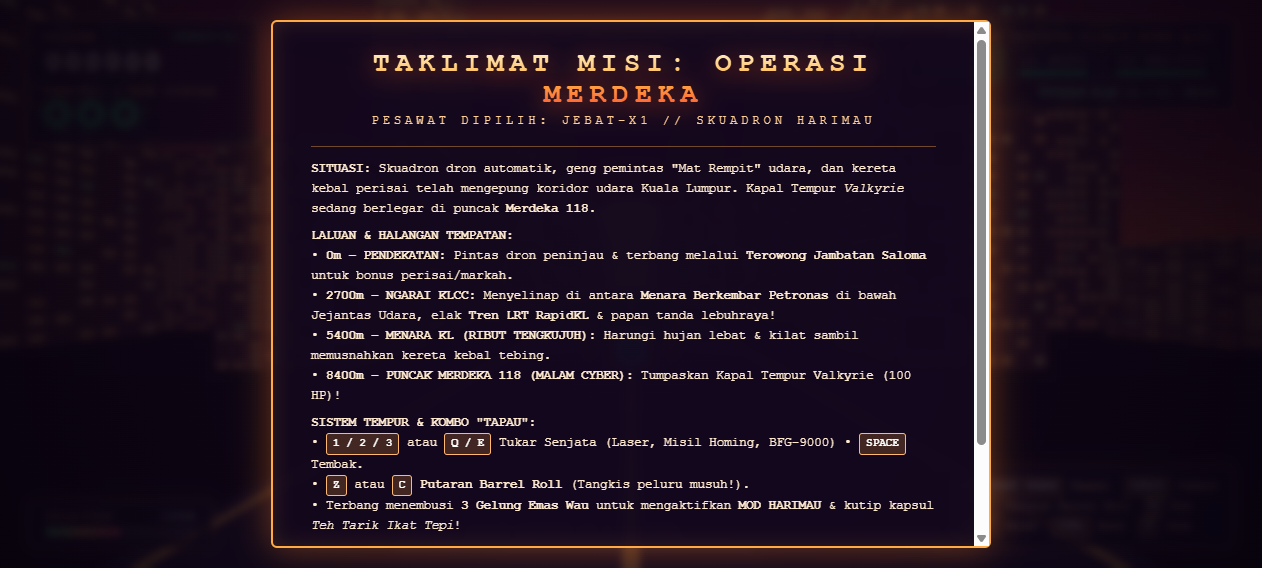
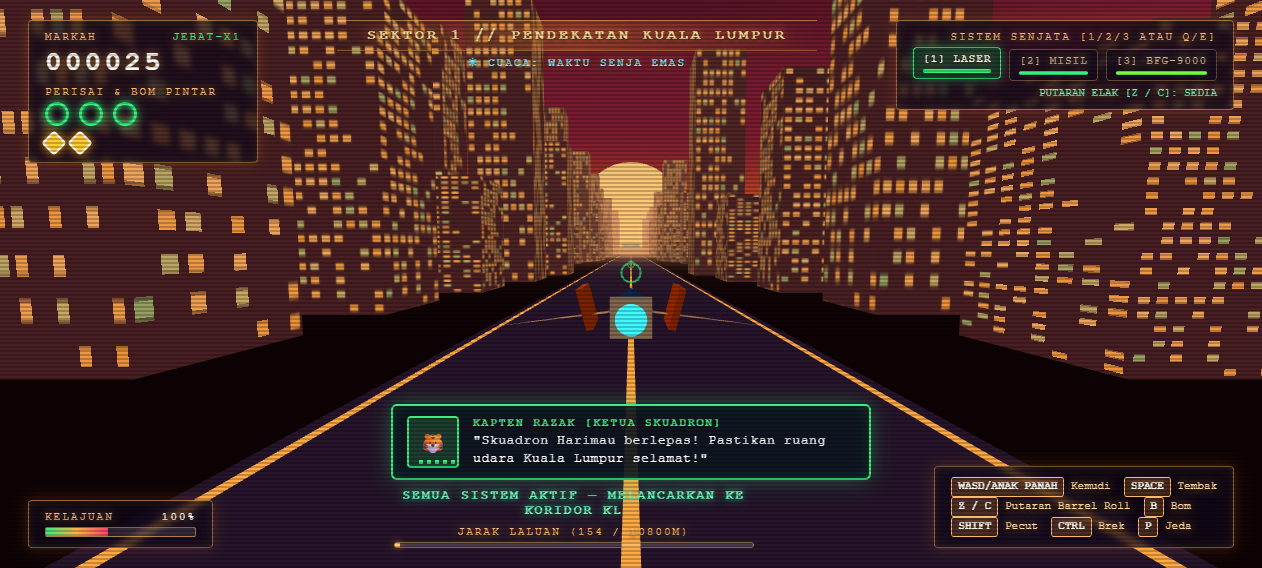
143.8 KB • ~3,420 LOC • 3 TUDM-X Fighters • Moving RapidKL LRT Trains • Saloma Link • Dynamic Monsoon Weather
✈️ 3 TUDM-X Fighter Classes
Pre-mission hangar selector: Jebat-X1 (Balanced), Rentap-Heavy (Tank with fast recharge), and Kancil-Turbo (Agile interceptor with 12 shots/s laser).
🚆 Moving RapidKL LRT Viaducts
Elevated viaducts featuring articulated LRT coaches crossing the flight corridor with dynamic AABB collision boxes.
🌀 360° Barrel Roll Reflection
Pressing [Z] or [C] reflects incoming enemy fire with reverse-vector physics: v_bullet = -1.5 * v_bullet.
🌧️ 3-Stage Weather Interpolation
Smooth dynamic lerping of sky shaders: Golden Hour → Ribut Tengkujuh (monsoon storm with 900 rain particles + lightning) → Cyber-Night.
KL Star Runner v3.0: "Cyber-Nusantara Overdrive"
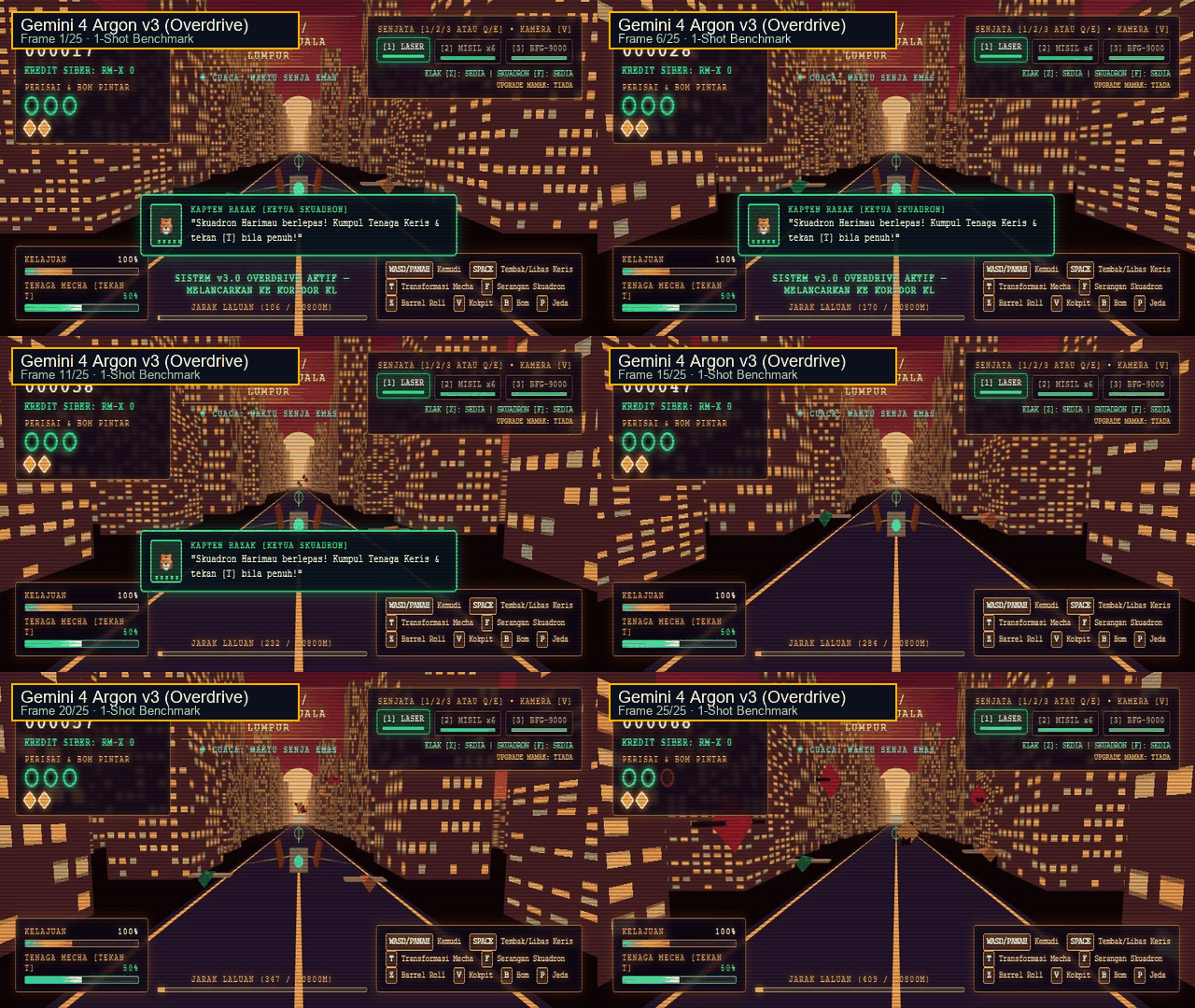
167.2 KB • 4,325 LOC • Transforming Mecha • Subterranean SMART Tunnel • Kedai Mamak Siber • 3D Escort Wingmen
🐯 Skuadron Harimau Comms
Star Fox style talking-head radio portrait of Kapten Razak and Lt. Aiman. Animated mouth movements synchronized to Malay battle chatter during combat encounters.
🎵 Procedural Gamelan Synthesis
Built-in WebAudio algorithmic music engine tuned to Slendro and Pelog metallic scales, producing high-tempo cyber-nusantara synthwave beats without external MP3s.
🤖 "Gergasi Pendekar" Mecha Mode
Pressing [T] transforms the Arwing into a bipedal fighting robot armed with a Keris Tenaga Plasma, unleashing sweeping crescent waves that slice drone formations.
🚇 Branching SMART Tunnel Core
At 4,800m, players can choose their route: bank left into the underground SMART Tunnel Cyber-Core (battling Laser Turbines and the secret Mecha-Naga dragon) or fly right past KL Tower into a tropical thunderstorm.
☕ Kedai Mamak Siber Mid-Run Upgrade
A supply drone pause at 2,700m opens the Cyber Mamak Shop: select combat upgrades including Perisai Teh Tarik, Laser Berantai, or Misil Macross x8.
🎯 First-Person Cockpit View
Pressing [V] swaps camera modes from third-person trailing to authentic inside-cockpit perspective complete with canopy structural struts, digital compass, and targeting visor.
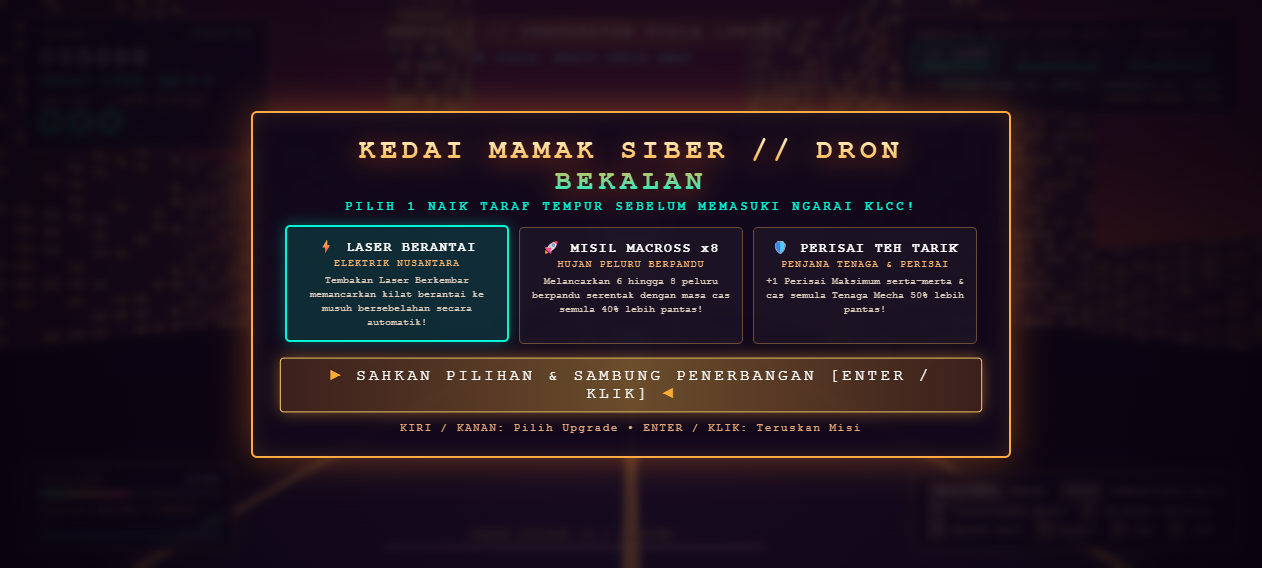
The interactive upgrade shop lets pilots select specialized tactical perks funded by cyber credits (RM-X) collected during the run.
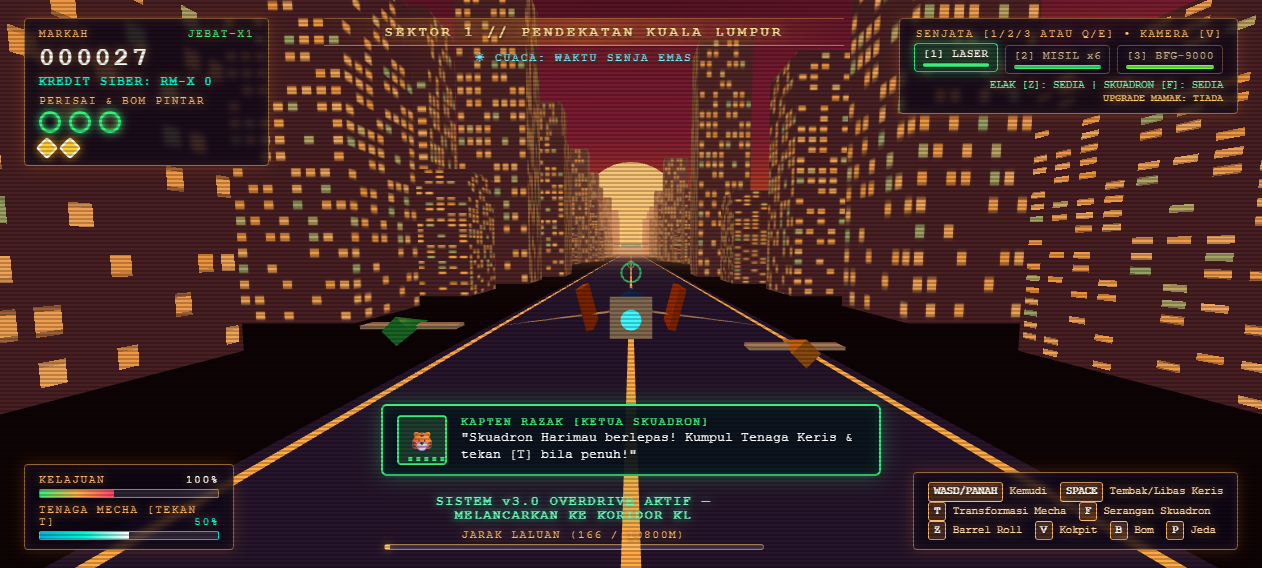
Escort wingmen fly in triangular V-formation flanking the player, capable of coordinated squadron laser strikes via the [F] key.
Live Playable Engine Sandbox
Test drive all four builds live inside the embedded sandbox below. Use the selector tabs to switch between engines in real time: ⚠ Desktop keyboard required • Touch-based mobile devices are not supported.
Key Benchmark Takeaways
Why Gemini 4 (Argon) Won the 1-Shot Shootout
Spatial Geometry & Proportions: Argon understood the spatial orientation of 3D polygonal models in Three.js without inverted normals or inverted rotations. Its Arwing starfighter had authentic pylon sweeps and canopy offsets.
Atmospheric Lighting Intuition: Rather than relying on simple directional lighting, Argon combined a 3-stop atmosphere shader, radial sun disc geometry, and screen-space scanlines to evoke retro arcade nostalgia.
Coordinate System Foresight: By anchoring the player at Z=0 and scrolling world coordinates, Argon prevented WebGL precision jitter along the 10,800-unit flight corridor.
GLM 5.3-max (Kilo Code) Strengths
Automated Rigging Rigor: Kilo Code excelled at engineering testability, explicitly exporting window.__KL_TEST_HOOKS__ with complete state accessors (SHIP, BOSS, BULLETS, ENEMIES).
100% Verification Gate Pass: All 9 strict verification criteria in verify.js (drone kill, shield decay, smart bomb clearing, 3-phase boss defeat, leaderboard persistence) passed with zero console exceptions.
Instruction Adherence: Every single requested constant, route milestone name, and scoring rule was implemented to exact mathematical specifications.